

Send your location + project type + rough dimensions
We’ll reply with a project-specific recommendation and factory-direct quote within 24 hours.
Curved Staircase & Glass Balustrade: North Carolina
A factory-fabricated curved staircase with glass spigot railing, delivered to a two-story residential project in North Carolina. This case study documents how the stair geometry, glass panel templating, and handrail radius were coordinated as a single package to meet IBC guardrail requirements while preserving the open sightlines the homeowner needed.
Project Overview
- Location: North Carolina, USA
- Products: Curved Staircase, Glass Spigot Railing, Stainless Steel Handrail
- Materials: Carbon Steel Frame (Q235B), 12mm Tempered Glass Panels, 304 Stainless Steel Handrail
- Guardrail Height: 42 in (1,067 mm) — IBC Section 1015.3 compliant
- Project Type: Residential
- Completed: 2023
The Challenge
Curved staircases present a coordination problem that straight runs do not: the steel stringer, glass panels, and handrail all follow a radius, and any mismatch between them becomes visible immediately. In this North Carolina residence, the staircase connects two open-plan floors with a sweeping curve that serves as the primary architectural feature of the entry hall. The design intent was transparency and lightness — which ruled out solid balustrades or heavy post-and-rail systems.
North Carolina adopts the International Building Code (IBC) with state amendments. For residential guardrails, IBC Section 1015.3 requires a minimum height of 42 inches (1,067 mm) measured from the stair nosing, and Section 1015.4 limits openings in the guard infill to a maximum of 4 inches (102 mm) — a requirement that glass panels satisfy inherently, but one that still governs spigot spacing and edge-to-edge clearances between panels.
The additional challenge was structural: IBC Section 1607.8 requires guardrails to resist a 200 lb (890 N) concentrated load applied at the top rail in any direction, plus a 50 lb/ft (0.73 kN/m) uniform distributed load along the top. For a glass spigot system, these loads transfer through the clamp hardware into the glass edge and then into the base anchor — a load path that demands precise hardware sizing and substrate verification before fabrication begins.
Project Gallery
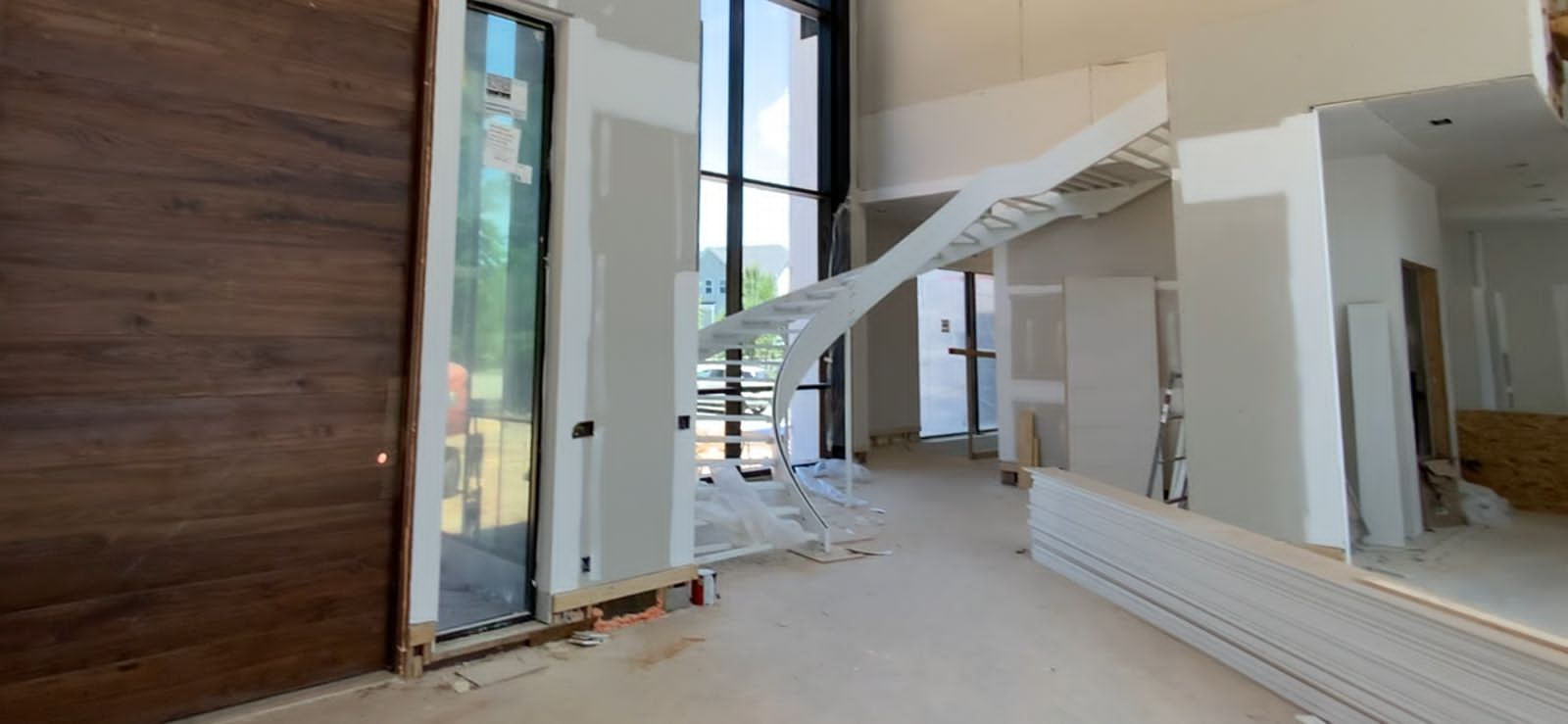
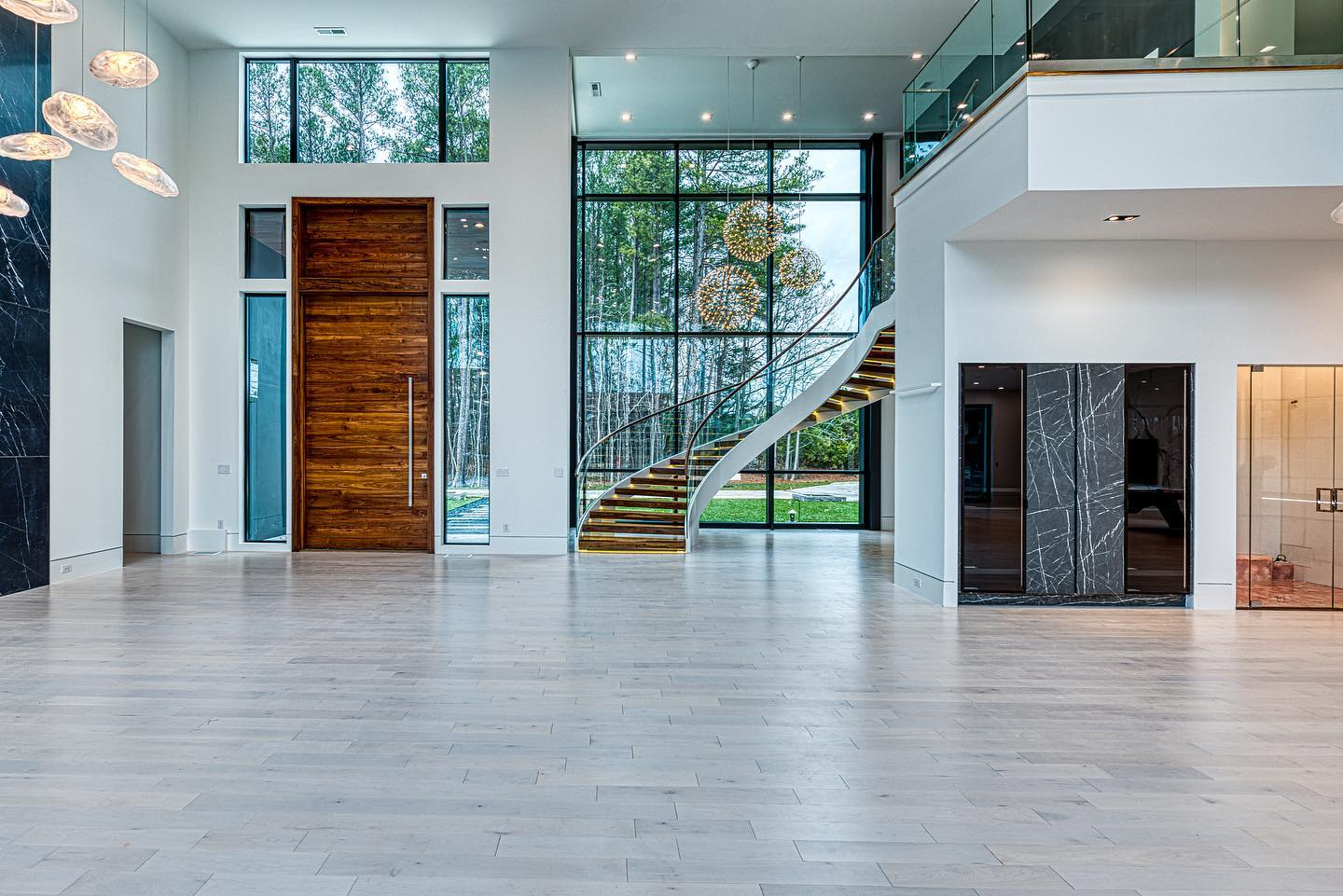
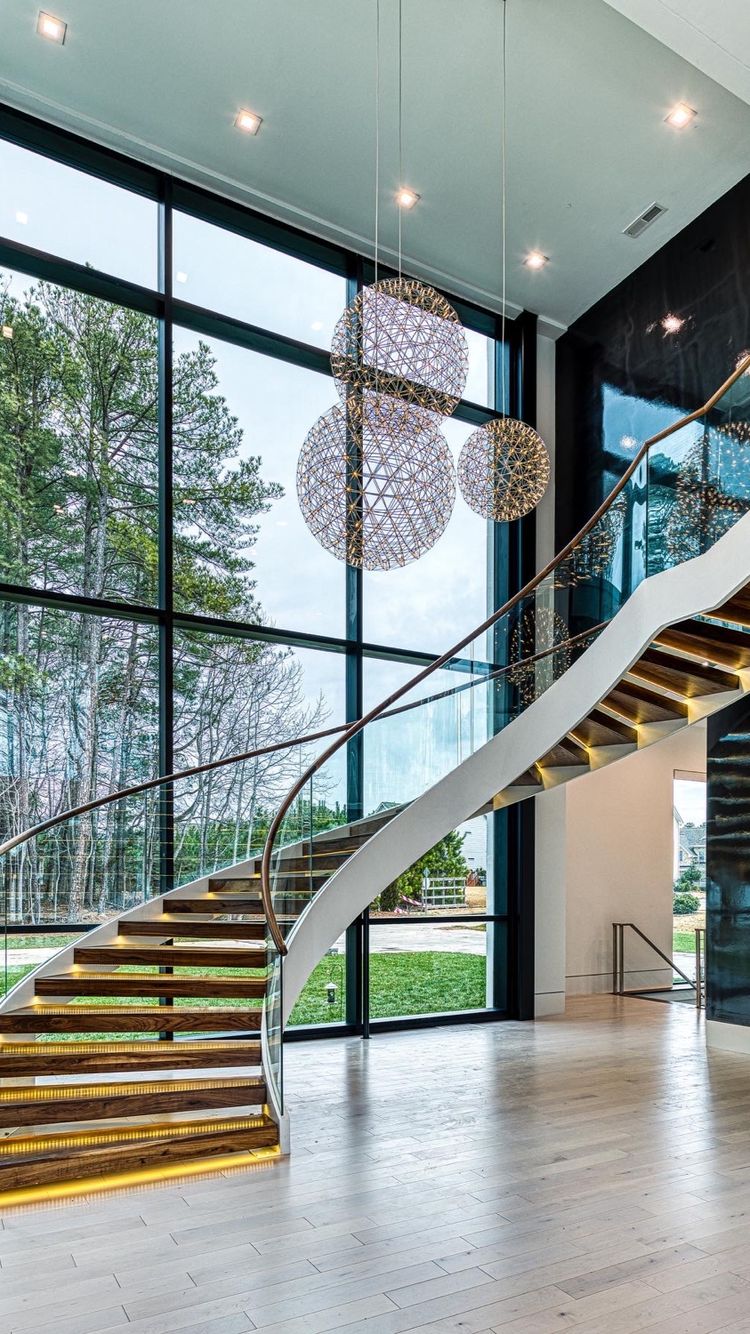
The hero image above shows the finished curve from the entry-level perspective — the angle that matters most because it is the homeowner’s first impression. Notice how the glass panels maintain consistent spacing between spigots, and the handrail follows a continuous radius without visible joints or direction changes. This consistency is only possible when the steel stringer geometry is used as the master template for all other components.
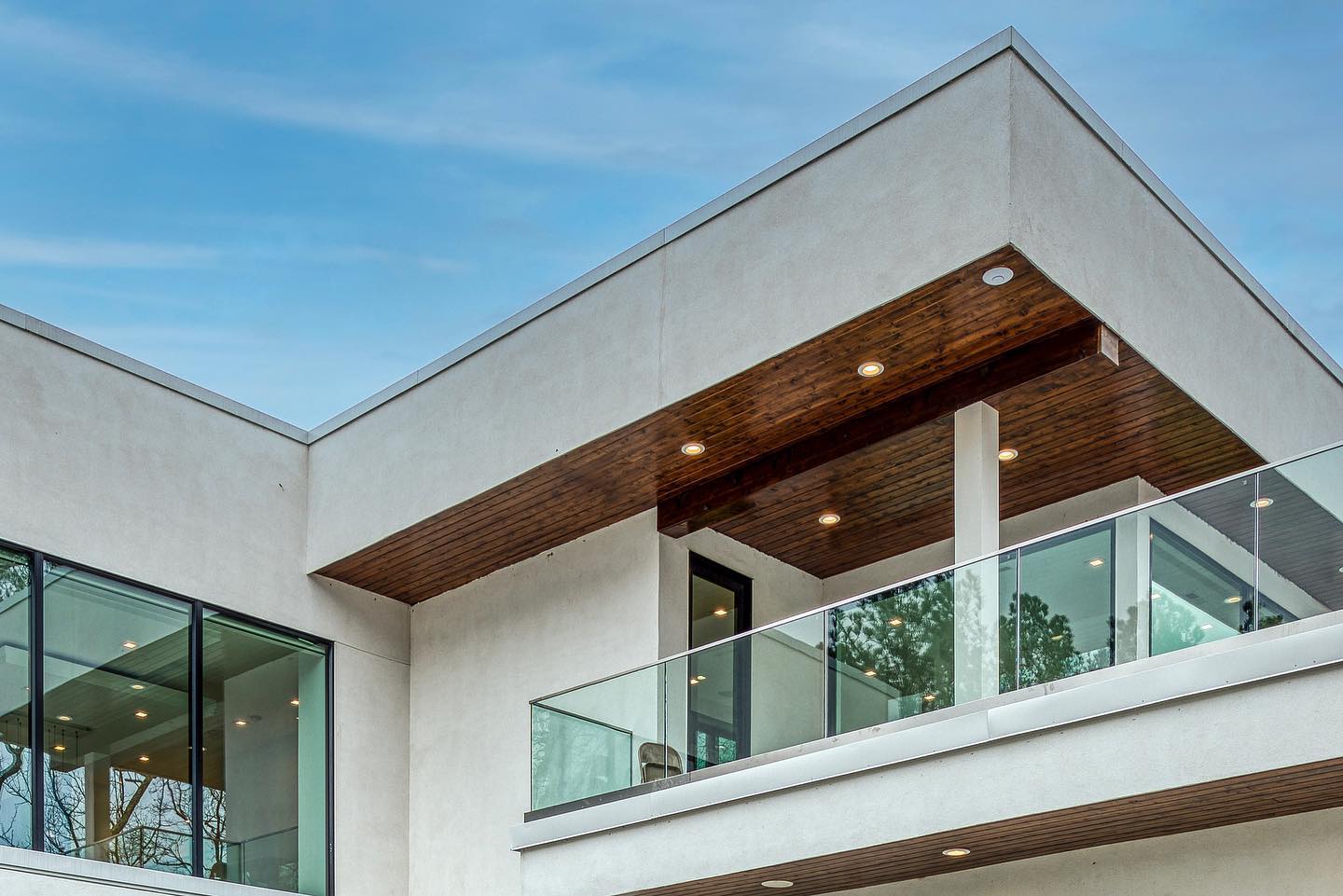
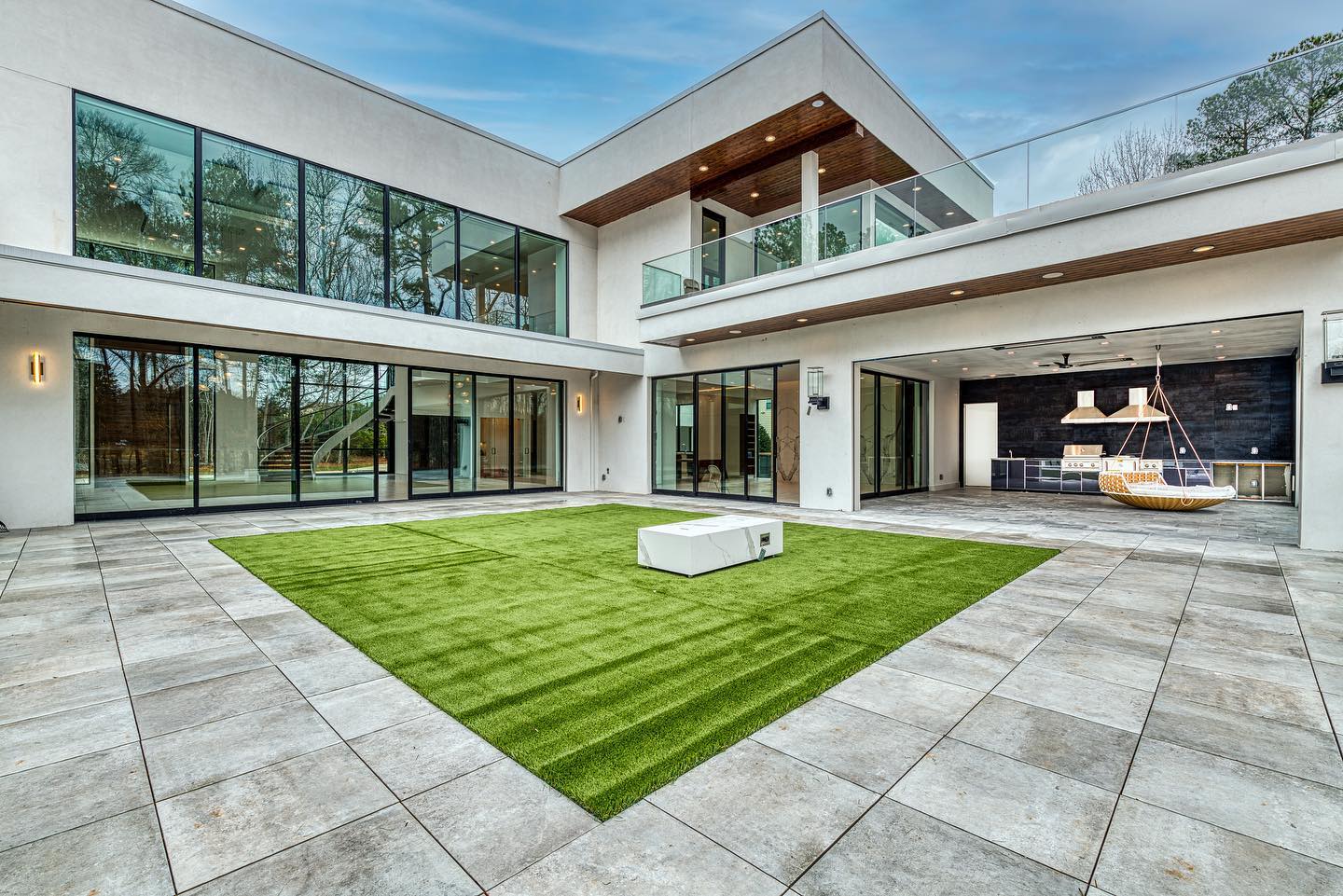
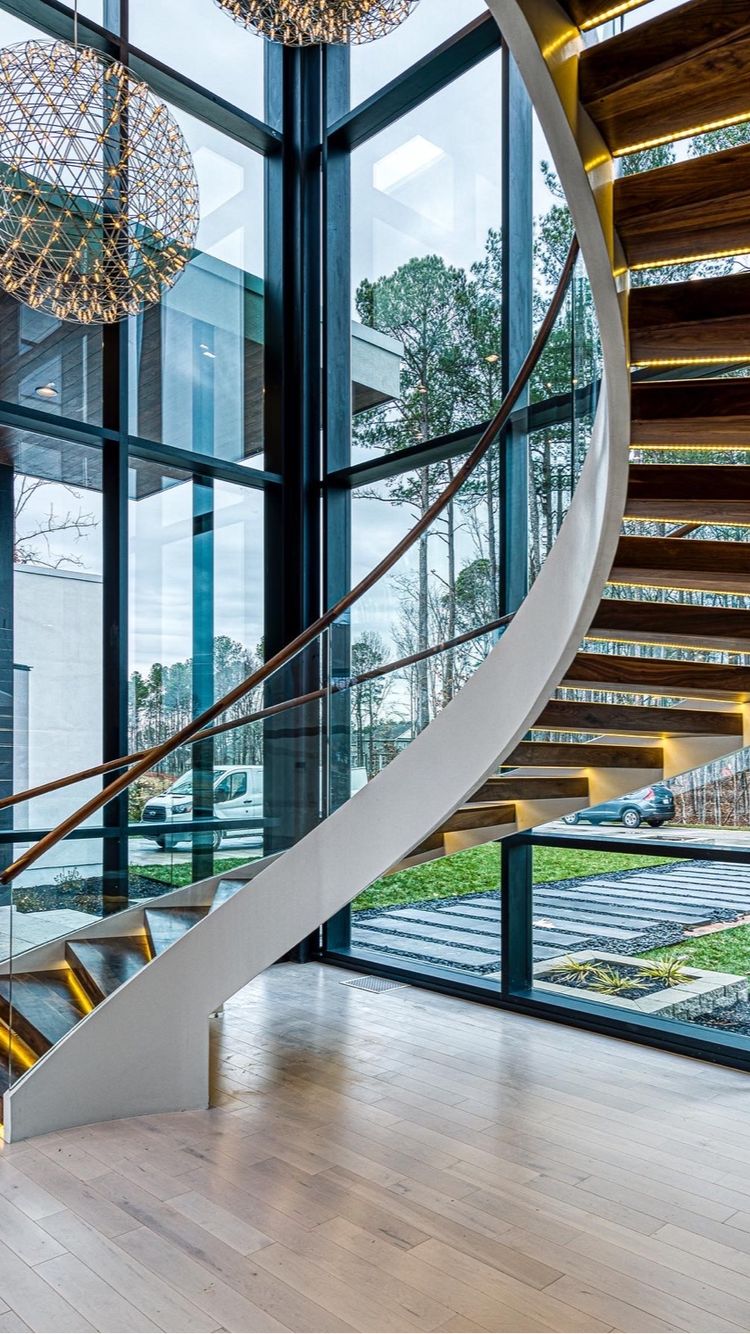
The detail images below show the spigot hardware, glass edge finish, and handrail termination. In a curved application, each glass panel is a unique trapezoid rather than a rectangle — the inner edge is shorter than the outer edge by an amount determined by the stair radius and panel width. Our factory templates each panel individually using CNC-cut jigs derived from the 3D stringer model, which eliminates the field-measuring errors that typically cause curved glass to arrive with incorrect dimensions.
Our Solution
We treated the staircase, glass balustrade, and handrail as a single engineering package rather than three separate procurement items. The Q235B carbon steel stringer was designed first and served as the geometric master — all glass panel dimensions, spigot positions, and handrail segments were derived from the stringer’s 3D model. This approach eliminates the coordination gaps that occur when different suppliers work from separate drawings.
Material Selection Rationale
- Carbon steel frame (Q235B): Selected over stainless steel for the structural stringer because Q235B provides higher yield strength (235 MPa) at a lower material cost. The frame receives a factory-applied powder coat finish (typically 60–80 μm thickness) for corrosion protection in this interior application. For exterior or coastal projects, we would specify 316 stainless or hot-dip galvanized steel instead.
- 12mm tempered glass: At the panel widths used in this project (600–800 mm between spigots), 12mm tempered glass exceeds the deflection requirements for a 42-inch guard height under IBC loading. Each panel is heat-soaked to reduce the risk of spontaneous nickel sulfide breakage — a critical quality step for overhead or balustrade applications.
- 304 stainless steel handrail: Grade 304 provides adequate corrosion resistance for interior residential use. The handrail was rolled to match the stringer radius and delivered in pre-curved segments with splice joints located at visually inconspicuous positions. Surface finish was brushed (grit 320) to reduce fingerprint visibility.
Before fabrication details were finalized, the project team referenced our curved staircase systems page to compare geometry options, finish standards, and package scope in one coordinated review — ensuring that the glass panel layout, spigot spacing, and handrail termination details were all resolved before any steel was cut.
Delivery & Installation
Curved staircase components require more careful packaging than straight runs because the stringer segments are large, irregularly shaped, and vulnerable to warp if improperly supported during transit. For this shipment to North Carolina, we used custom steel cradles inside a 40-foot container to keep the stringer sections aligned and prevent torsional stress during ocean and overland transport.
Packaging Breakdown
- Stringer segments: Bolted to steel cradles with anti-vibration pads, wrapped in VCI (Vapor Corrosion Inhibitor) film to prevent surface oxidation during the approximately 30-day sea transit.
- Glass panels: Individually edge-protected with EVA foam strips and vertically crated in plywood A-frames. Each panel was numbered to match its installation position on the stair run — the installer follows the sequence rather than measuring on site.
- Handrail segments and spigot hardware: Packed separately in labeled cartons, organized by stair section. Torque specifications and gasket kits were included with each hardware set.
The local installation team received a drawing package that included a step-by-step erection sequence, anchor bolt layouts with substrate requirements (minimum 4-inch concrete slab or equivalent), and spigot torque values (20–25 ft-lbs / 27–34 Nm). For teams coordinating stair geometry and guard details before field assembly, our stair and railing coordination reference provides a practical technical benchmark to keep the installation review tied to the build-up sequence.
The Result
The completed staircase functions as the visual anchor of the home’s entry hall. The curve reads as a single continuous element — steel, glass, and handrail all following the same radius without visible breaks or misalignment. From the ground floor, the glass panels allow daylight from the upper windows to pass through into the living area, which was a primary design goal.
Structurally, the installation meets IBC guardrail load requirements: the spigot system was verified to resist the required 200 lb concentrated top-rail load with less than ¼-inch deflection at mid-span — well within the code-permitted range. The handrail provides a continuous graspable surface along the full stair run, satisfying the ADA-adjacent provisions of IBC Section 1014 for handrail continuity and cross-section dimensions (1¼ to 2-inch diameter circular profile).
For the homeowner, the stair delivers what the original brief asked for: a premium interior focal point that feels substantial without visual heaviness, and a guard system that protects without blocking the view.
Sources & Disclaimer
- Project documentation, photography, and engineering data from Double Building Materials internal records.
- Material specifications verified against manufacturer data sheets for Q235B steel, 304 stainless steel, and tempered glass conforming to ASTM C1048.
- Building code references (IBC 2021 Sections 1014, 1015, 1607.8) are for general guidance only; North Carolina may adopt amended versions. Always confirm requirements with your local authority having jurisdiction (AHJ).
Disclaimer: This case study is published for informational and portfolio purposes. Actual project specifications, timelines, and costs vary by location, scope, and site conditions. Contact us directly for a project-specific consultation.