

Send your location + project type + rough dimensions
We’ll reply with a project-specific recommendation and factory-direct quote within 24 hours.
This custom staircase Houston project delivered a steel stair with glass railing for a new-build residence in Texas. The case study examines the material engineering challenges of Houston’s Gulf Coast climate — extreme heat, sustained UV, and high humidity demand specific coating chemistry and fastener selections — alongside structural design under IBC as adopted by the City of Houston.
Project Overview
- Location: Houston, Texas, USA
- Products: Custom Steel Staircase, Glass Railing, Steel Handrail
- Materials: Q235B Carbon Steel (TGIC polyester powder-coated), 10mm Tempered Glass, Powder-Coated Steel Handrail
- Guardrail Height: 42 in (1,067 mm) — IBC §1015.3 / City of Houston amendments
- Powder Coat: TGIC Polyester, RAL 7021 Black Grey, 100 μm DFT — UV and humidity resistant
- Project Type: Residential New Construction
- Completed: 2023
The Challenge
Houston’s Gulf Coast climate is one of the most demanding environments for finished metal products in the United States. Average summer temperatures exceed 35°C (95°F), relative humidity averages 75% year-round, and the annual UV index is among the highest in the continental US. For a staircase installed in a new-build Houston home, these conditions affect the coating specification more than any other single factor — standard powder coats that perform well in temperate climates can chalk, fade, or lose adhesion within 3–5 years under Houston’s UV and humidity combination.
The City of Houston adopts IBC with local amendments through the Houston Construction Code. For residential guards, the requirements follow IBC §1015.3: 42-inch (1,067 mm) minimum height at open sides of stairs and landings. Houston’s Building Code Enforcement office reviews custom stair and guard systems during the permit process, and for new construction (as opposed to retrofit), the staircase design must be included in the structural drawings submitted with the building permit application.
The staircase in this project connects the ground floor to an upper mezzanine level in an open-plan living area with large south-facing windows. The south orientation means the staircase receives direct sunlight for several hours daily during Houston’s 8-month warm season — creating a UV exposure environment that is closer to an exterior application than a typical interior installation. This drove the coating specification toward exterior-grade chemistry even though the staircase is fully interior.
Project Gallery
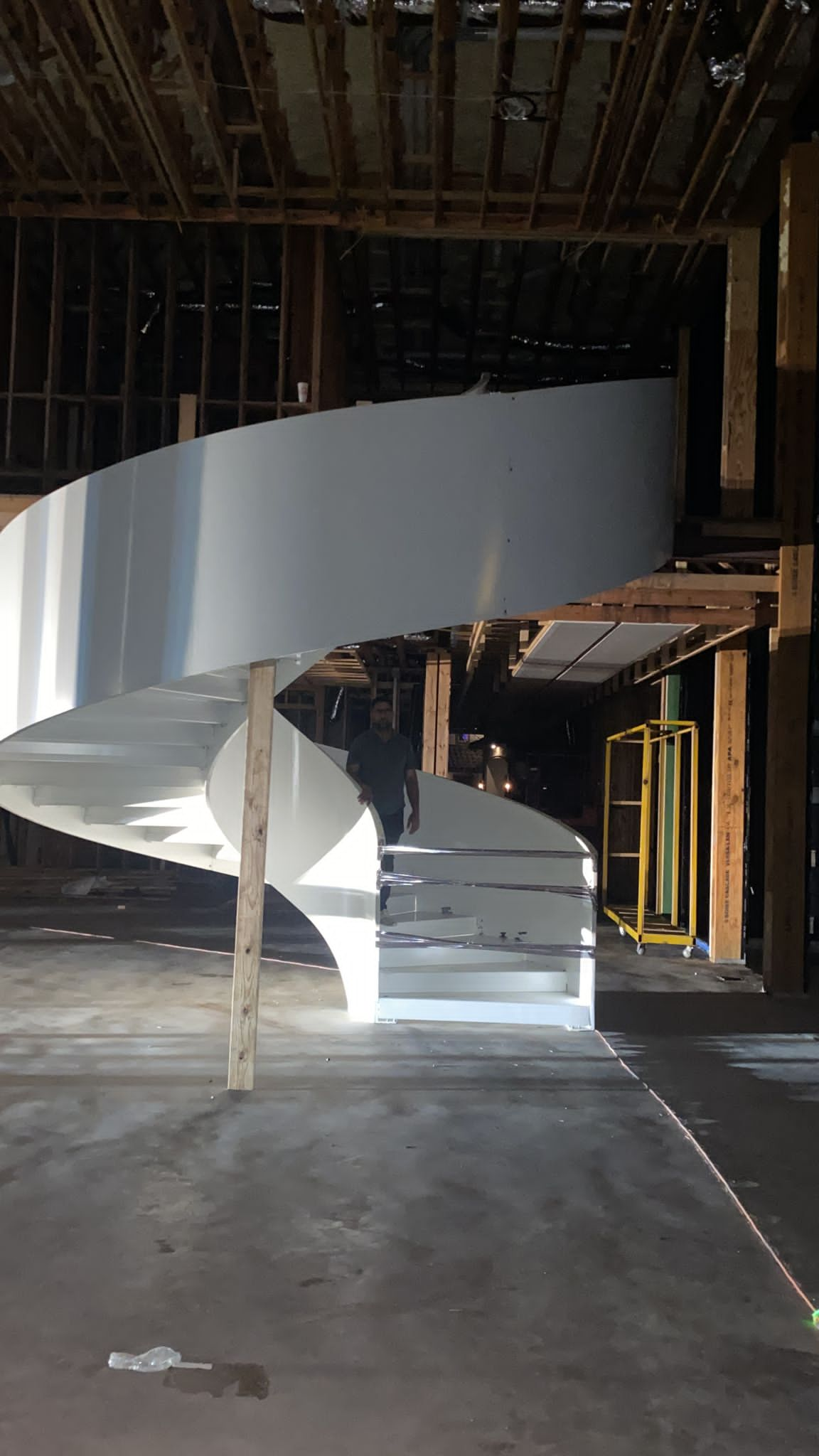
The image shows the staircase in its completed environment. Note the natural light flooding the space from the south-facing windows — this is the UV exposure that drove the TGIC polyester coating specification. The RAL 7021 Black Grey finish (a warm, charcoal-toned black) was selected over pure RAL 9005 Jet Black because dark colours absorb more solar radiation and the slight warmth in 7021 reduces the perceived contrast in a sun-filled room. Our straight staircase systems are available with both standard polyester and TGIC polyester powder coat — the TGIC formulation is recommended for any installation receiving sustained direct sunlight, whether interior or exterior.
Our Solution
Coating Chemistry for Gulf Coast Climate
The critical specification decision was the powder coat chemistry. We selected TGIC (triglycidyl isocyanurate) polyester over standard PRIMID (HAA) polyester for three performance reasons specific to Houston:
- UV resistance: TGIC polyester provides superior gloss and colour retention under UV exposure. In accelerated weathering tests (ASTM G154), TGIC formulations typically retain >80% gloss after 1,000 hours of UV exposure, versus 50–60% for standard polyester. In Houston’s sustained UV environment, this translates to an expected 10–15 year interval before visible chalking, versus 5–7 years for standard chemistry.
- Humidity resistance: TGIC crosslinking produces a denser film with lower moisture permeability than PRIMID chemistry. Houston’s year-round high humidity (75%+ average RH) creates conditions where moisture can penetrate porous coatings and initiate filiform corrosion beneath the film — a failure mode that appears as worm-track patterns on the coated surface.
- DFT specification: 100 μm minimum DFT (dry film thickness) over SA 2.5 blast-cleaned surface. The higher DFT (standard residential specification is 60–80 μm) provides additional barrier thickness as insurance against the aggressive Houston environment.
Structural Design
- Stringer: Twin C-channel stringers in Q235B carbon steel, sized for residential loading (40 psf live load per IBC Table 1607.1). The twin-stringer layout provides lateral stability without the need for intermediate support, allowing the area beneath the stair to remain open for the owner’s use.
- Treads: 6mm steel plate with anti-slip raised pattern, welded to stringer brackets. Treads are 1,000 mm wide (clear between stringers), exceeding the IBC minimum of 36 inches (914 mm).
- Glass railing: 10mm tempered glass panels (ASTM C1048) held by stainless steel spigots at the tread level. Guard height: 42 inches from the nosing line.
Delivery & Installation
Houston’s logistics are more permissive than dense urban markets — most new-build residential sites have driveway access and wide garage openings. The staircase was delivered in pre-assembled stringer sections (maximum 3 m length) via standard trucking from Port Houston, with total transit time of approximately 28 days from factory to site.
- Timing consideration: Houston construction scheduling must account for hurricane season (June–November). The staircase was shipped to arrive during the spring construction window, when the building was under roof but interior finishes were not yet applied — reducing the risk of weather-related shipping delays and eliminating the need for finish protection during the install phase.
- Heat management during install: Summer installation in Houston requires awareness of steel surface temperatures. On a 38°C day, a dark-coated steel stringer in direct sunlight can reach 60°C+ — too hot for safe handling without gloves. The installation was scheduled for early morning hours (6:00 AM start) to work in cooler conditions before the sun reached the south-facing windows.
For contractors in Gulf Coast markets where coating durability and installation timing are critical project variables, our stair and railing coordination reference includes climate-specific coating selection guidance and installation scheduling recommendations.
The Result
The completed staircase delivers a clean, modern connection between the ground floor and mezzanine, with the glass railing maintaining visual openness across the south-facing living area. The TGIC polyester powder coat in RAL 7021 provides a consistent charcoal finish that absorbs the direct sunlight without the harsh contrast of a pure black, and the 100 μm DFT specification provides the coating durability needed for Houston’s demanding UV and humidity combination.
The staircase complies with IBC §1015.3 as adopted by the City of Houston: 42-inch guard height, 200 lb concentrated top-rail load resistance, and infill preventing passage of a 4-inch sphere. The twin-stringer construction provides the residential loading capacity required by IBC Table 1607.1 while maintaining a visually balanced proportion in the open-plan space.
Sources & Disclaimer
- Project documentation and photography from Double Building Materials internal records.
- Material specifications verified against ASTM C1048 (tempered glass), Q235B steel data sheets, and TGIC polyester powder coat conforming to AAMA 2604.
- Building code references (IBC 2021, Houston Construction Code) are for general guidance only. Always confirm with the City of Houston Building Code Enforcement office.
Disclaimer: This case study is published for informational and portfolio purposes. Actual project specifications, timelines, and costs vary by location, scope, and site conditions. Contact us with your project location and sun exposure details for a climate-specific coating recommendation.