

Send your location + project type + rough dimensions
We’ll reply with a project-specific recommendation and factory-direct quote within 24 hours.
This glass railing San Diego project installed a stainless steel post system on a residential deck and balcony in coastal Southern California. The case study covers marine salt atmosphere, sustained UV exposure, and CBC seismic requirements — and explains why 316L stainless steel was specified over 304 for the posts and hardware in this near-ocean installation.
Project Overview
- Location: San Diego, California, USA
- Products: Glass Railing, Stainless Steel Posts, Stainless Steel Handrail
- Materials: 316L Stainless Steel Posts and Handrail (PREN ≥ 25), 12mm Tempered Glass (ASTM C1048)
- Guardrail Height: 42 in (1,067 mm) — CBC / IBC §1015.3 compliant
- Application: Exterior deck and balcony (coastal exposure)
- Distance from Coast: Approximately 0.8 km (within marine aerosol zone)
- Project Type: Residential
- Completed: 2023
The Challenge
San Diego’s coastal residential zones present a triple challenge for exterior metalwork: marine salt atmosphere, intense year-round UV (the city averages 266 sunny days per year), and CBC seismic requirements. This project was located approximately 0.8 km from the Pacific coast — well within the marine aerosol zone where airborne chloride concentrations are high enough to cause pitting corrosion on 304 stainless steel within 2–5 years of installation.
For exterior glass railings in this environment, the material selection is the most consequential engineering decision. Standard 304 stainless steel (18Cr-8Ni, PREN ≈ 18) is adequate for interior applications and non-coastal exteriors, but its Pitting Resistance Equivalent Number is insufficient for marine atmosphere exposure. At PREN 18, 304 stainless will develop tea-staining (superficial rust staining from chloride attack on the passive layer) within 12–24 months, progressing to pitting corrosion at stress concentration points (bolt holes, weld toes) within 3–5 years.
California’s Building Code (CBC) adds the seismic design layer: San Diego is in Seismic Design Category D (high seismic), requiring that the railing system accommodate inter-story drift and resist seismic forces without structural failure. For an exterior deck railing, the seismic consideration primarily affects the post-to-deck connection — the anchoring system must maintain its structural integrity through seismic cycling without cracking the concrete deck slab or pulling the post base free.
Project Gallery
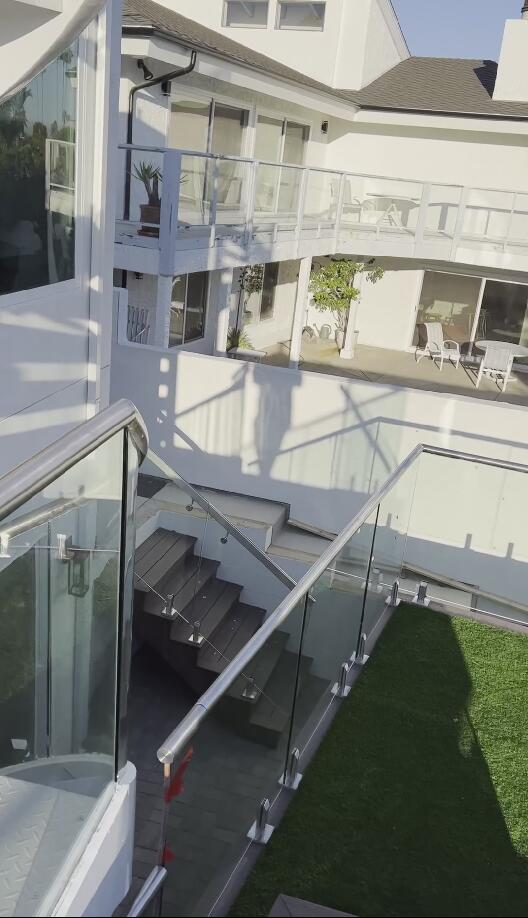
The hero image shows the glass railing on the exterior deck with the coastal environment visible beyond. In this setting, the railing hardware is directly exposed to salt-laden onshore winds — every component visible in the image (posts, clamps, handrail, fasteners) must be marine-grade to survive the environment. Our glass railing systems are available in both 304 and 316L stainless steel configurations, with 316L automatically specified for any installation within 1.5 km of a saltwater coast.
Our Solution
316L Stainless Steel — The Marine-Grade Decision
All metal components — posts, clamps, handrail, fasteners, and anchor bolts — were specified in 316L stainless steel (17Cr-12Ni-2.5Mo). The molybdenum content raises the PREN to approximately 25, which provides reliable pitting resistance in marine C4 atmospheric corrosivity (ISO 9223 classification for coastal environments within 1 km of the sea). Key specifications:
- Posts: 50.8 mm (2″) round tube, 316L, wall thickness 2.5 mm. Brushed to 320-grit finish — the directional brush pattern helps shed salt deposits and simplifies cleaning with fresh water.
- Fasteners: All bolts, nuts, and washers in A4-80 (316 stainless, 800 MPa tensile). Using 304 fasteners in a 316L assembly creates galvanic cells at the bolt interfaces — a common error that causes accelerated corrosion at the very points where structural integrity is most critical.
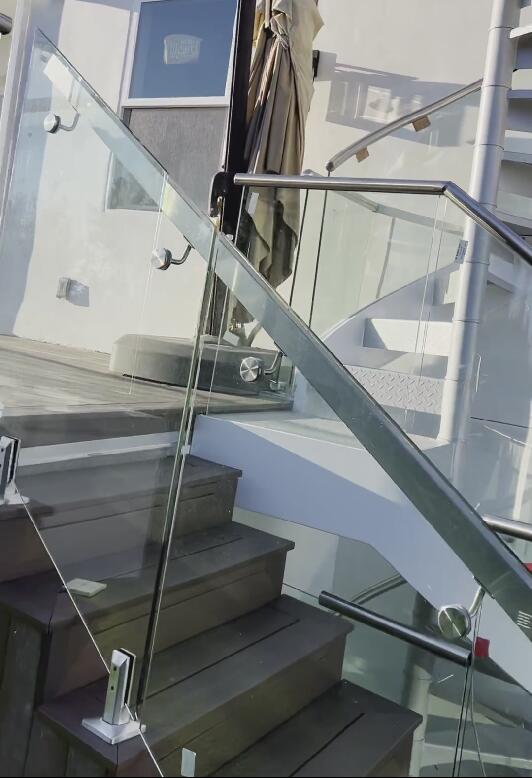
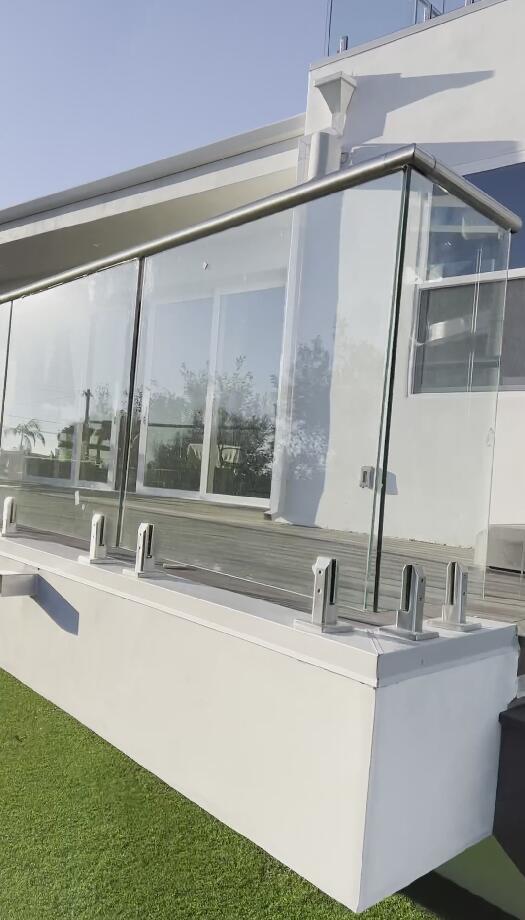
- Glass clamps: Investment-cast 316L, polished to 400-grit. The clamp design includes EPDM gasket pads that isolate the glass from the metal, preventing both galvanic effects and direct mechanical contact.
Glass Specification
- 12mm tempered glass: Upgraded from 10mm for exterior application where wind loads supplement the IBC guardrail load. San Diego’s basic wind speed is 110 mph (ASCE 7-22); the 12mm thickness provides adequate resistance to the combined guardrail load (200 lbs concentrated) and wind pressure without excessive deflection.
- Low-iron option: The homeowner selected low-iron (Starphire-type) glass to eliminate the green tint visible in standard float glass when viewed edge-on — a detail that matters in a railing where the glass edge is at eye level and the Pacific view behind should be colour-neutral.
Delivery & Installation
San Diego residential delivery is straightforward — the city’s suburban layout provides vehicle access to most residential properties. The railing components were shipped via sea freight to the Port of Long Beach, then trucked 120 miles south to the project site (total transit approximately 30 days).
- Post anchoring: Core-drilled into the concrete deck slab using 316L stainless chemical anchors (M12, 120 mm embedment). The chemical anchor system (epoxy-based, conforming to ACI 318 Appendix D) provides the seismic cycling resistance required for SDC D — mechanical expansion anchors are less suitable in seismic zones because cyclic loading can cause progressive slip.
- Passivation treatment: After installation, all 316L components received an on-site passivation treatment (citric acid solution per ASTM A967) to restore the chromium oxide passive layer after any fabrication marks, handling scratches, or iron contamination from tools. This step is essential for coastal installations — skipping it can result in tea-staining within the first 6 months.
For coastal projects where marine-grade material selection and post-installation passivation are critical, our stair and railing coordination reference includes a coastal installation checklist covering material verification, fastener matching, and passivation protocols.
The Result
The completed railing provides unobstructed Pacific views through low-iron tempered glass panels, with 316L stainless steel hardware that will maintain its appearance in San Diego’s marine atmosphere for the lifetime of the building. The 320-grit brushed finish on the posts and handrail ages gracefully in the coastal environment — developing a soft patina rather than the pitting and staining that would affect 304 stainless in the same location.
The railing meets CBC/IBC requirements: 42-inch guard height, 200 lb concentrated load capacity, 4-inch sphere infill test, and seismic anchoring suitable for SDC D. The 316L all-matching fastener specification eliminates the galvanic corrosion risk that is the most common failure mode in coastal stainless steel railings — a detail that distinguishes a properly engineered marine installation from a standard specification applied in the wrong environment.
Sources & Disclaimer
- Project documentation and photography from Double Building Materials internal records.
- Material specifications verified against ASTM A240/A276 (316L stainless), ASTM C1048 (tempered glass), and ISO 9223 (atmospheric corrosivity classification).
- Building code references (CBC, IBC 2021, ASCE 7-22) are for general guidance only. Always confirm with your local building department.
Disclaimer: This case study is published for informational and portfolio purposes. Actual specifications vary by project. For coastal installations, provide your distance from the coastline so we can recommend the appropriate stainless steel grade.