

Send your location + application + rough dimensions
Share the project type, site location, and basic scope. We’ll reply with a practical recommendation and quote.
This IBS 2025 Las Vegas cross-code guide bridges the gap for stair and railing buyers attending both BAU (Munich, January) and IBS (Las Vegas, February). Documents the critical engineering and compliance differences — DIN/EN vs. IBC, CE marking vs. code evaluation reports, Eurocode loading vs. IBC concentrated loads — and explains how to evaluate whether a single supplier can serve both markets from one production capability.
Code comparisons are for general guidance. Always confirm specific requirements with the local authority having jurisdiction (AHJ) for US projects or the relevant building control body for European projects.
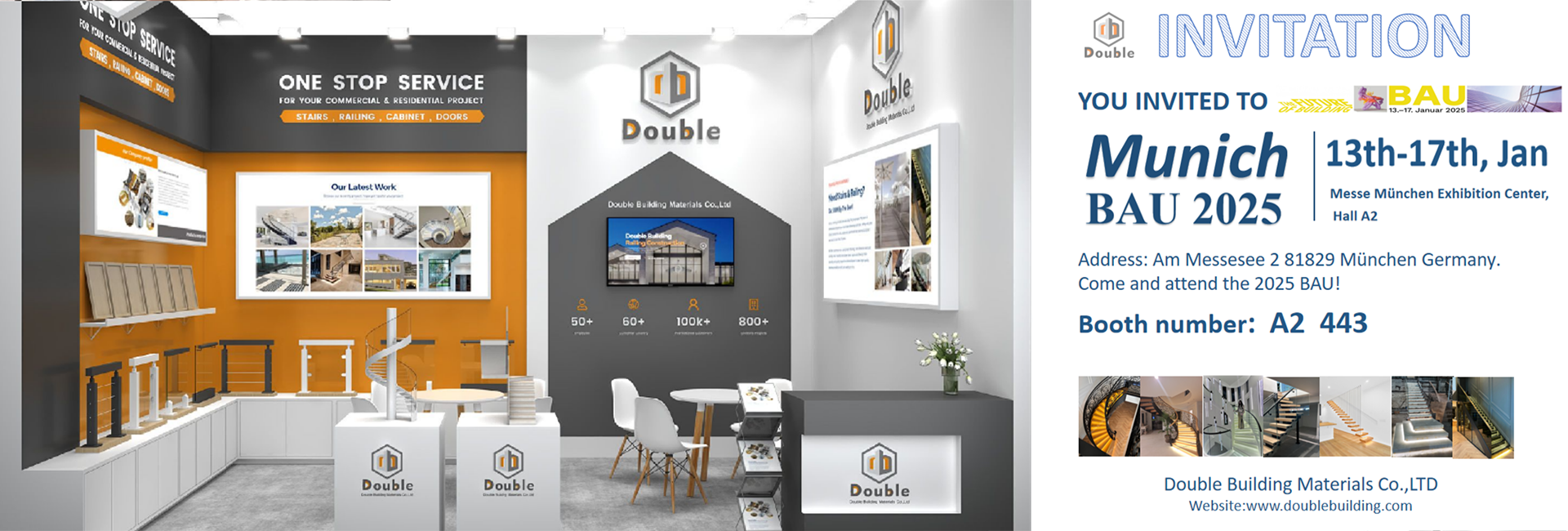
Two Shows, Two Code Worlds
BAU and IBS are separated by four weeks and 9,000 km — but the engineering and regulatory gap between the two markets is far wider than the geographic distance. BAU operates in the EN/DIN/Eurocode framework with mandatory CE marking under the EU Construction Products Regulation. IBS operates in the IBC/IRC framework with state-level code adoption and no equivalent of CE marking. A supplier who exhibits at both shows is implicitly claiming dual-market capability — but the reality is that very few suppliers can genuinely engineer, document, and certify their products for both frameworks.
For buyers who procure for both European and American projects (common among international architectural firms and global hotel/hospitality chains), the value of attending both shows is the ability to evaluate whether a single supplier can consolidate their stair and railing procurement across both code jurisdictions — reducing the number of qualified vendors from two to one. Our glass railing systems are engineered to meet both EN and IBC requirements, with documentation packages tailored to each market.
Guard Requirements: EN 1991 vs. IBC Side-by-Side
The fundamental engineering differences between European and American guard standards:
| Parameter | Eurocode / DIN | IBC (USA) |
|---|---|---|
| Loading model | Distributed line load (kN/m) | Concentrated point load (200 lbs / 890 N) |
| Residential load | 0.5 kN/m horizontal at top rail | 200 lbs at any point along top rail |
| Commercial load | 1.0 kN/m horizontal at top rail | 200 lbs (same as residential) |
| Residential guard height | 900 mm (DIN 18065, ≤12 m fall) | 36 in (914 mm) — IRC R312.1.1 |
| Commercial guard height | 1,100 mm (>12 m fall height) | 42 in (1,067 mm) — IBC §1015.3 |
| Infill restriction | 100 mm sphere (EN 1991-1-1) | 4 in / 102 mm sphere (IBC §1015.4) |
| Compliance documentation | CE marking + DoP (CPR 305/2011) | Code evaluation report or engineer’s letter |
The critical difference is the loading model. Eurocode’s distributed line load (kN/m) tests the entire guard system uniformly, while IBC’s concentrated point load (200 lbs at any point) tests the weakest local span. A guard that passes IBC concentrated loading may fail Eurocode distributed loading (or vice versa) — they are not interchangeable tests. A dual-market supplier must verify their product against both loading models independently.
Compliance Paths: CE Marking vs. Code Evaluation Reports
- Europe (CE marking): Requires EN 1090 fabricator certification, Factory Production Control (FPC) audit by a Notified Body, and Declaration of Performance (DoP) for each product. This is a manufacturer-level certification — it applies to the factory, not just the product.
- USA (code compliance): The IBC does not have an equivalent of CE marking. Instead, compliance is demonstrated through engineering calculations, test reports, and/or code evaluation reports from recognized testing labs (e.g., ICC-ES Evaluation Reports). The building official (AHJ) in each jurisdiction makes the final compliance determination — there is no centralized EU-style product certification.
- Practical implication: A supplier with EN 1090 certification has demonstrated a level of manufacturing quality control (FPC) that typically exceeds what US building officials require. This means the EU compliance path is generally more demanding — a supplier who has achieved EN 1090 can usually satisfy US requirements with additional engineering documentation, but the reverse is not necessarily true.
Material Specification Differences
- Steel grades: European specifications reference EN 10025 grades (S235JR, S275JR, S355JR). American specifications reference ASTM grades (A36, A992). The properties are similar but not identical — S275JR (275 MPa yield) is close to A36 (250 MPa yield) but they are different standards with different test protocols. A dual-market supplier must maintain traceability to both standards.
- Glass standards: Europe uses EN 12150 (thermally toughened safety glass). The US uses ASTM C1048. Both specify tempered glass but with different test methods and marking requirements. A supplier shipping to both markets needs glass certified to both standards — or must demonstrate equivalence accepted by both jurisdictions.
- Stainless steel: Both markets use AISI/EN designations (304/1.4301, 316L/1.4404). The practical difference is the certification documentation — European buyers expect EN 10204 3.1 mill certificates, while US buyers typically accept standard mill certifications. The material is the same; the paperwork differs.
For projects spanning both code jurisdictions, our stair and railing coordination reference includes a cross-standard material equivalence table mapping EN grades to ASTM grades with the documentation requirements for each market.
Can One Supplier Serve Both Markets?
Yes — but only if they can demonstrate all of the following:
- EN 1090 certification (for EU market access) AND the ability to provide IBC-compliant engineering calculations (for US market access)
- Material traceability to both EN 10025 and ASTM A36/A992 standards
- Glass sourcing with dual EN 12150 / ASTM C1048 certification
- Coating specifications meeting both AAMA (US) and Qualicoat (EU) standards
- Documentation packages tailored to each market: DoP for EU, engineering letter for US
At both BAU and IBS, ask the supplier directly: “Can you show me a completed documentation package for a European project AND a completed documentation package for a US project?” If they can produce both, they have genuine dual-market capability. If they can only produce one, they are a single-market supplier marketing at an international show.
Sources & Disclaimer
- Code comparison based on EN 1991-1-1, IBC 2021, DIN 18065, and CPR 305/2011.
- Material standard equivalences based on EN 10025, ASTM A36, EN 12150, and ASTM C1048 published specifications.
Disclaimer: This cross-code guide is for general procurement reference. Specific compliance requirements depend on the jurisdiction, building type, and local amendments. Consult your structural engineer for project-specific code determination.